
1408 | Catharsis in a Room
Forgotten Cinema: Horror Review by Michael Field
Anyone want to check out haunted hotel rooms?
If your Mike Enslin, that answer is “hell yeah”!
1408 is a supernatural thriller that relies more on psychological dread than cheap jump scares. Directed by Mikael Håfström (Derailed, EscapePlan), and starring John Cusack as Mike Enslin, an author who makes a living debunking haunted hotel rooms. Samuel L. Jacksonco-stars as Gerald Olin, the Dolphin Hotel’s ominous, increasingly desperate manager, while Mary McCormack rounds out the cast as Mike’s estranged wife, Lily.
Based on Stephen King’s short story, which itself was partially inspired by a collection of real-life news stories of a parapsychologist who actually investigated a haunted hotel room at the Hotel Del Coronado in California and another undisclosed hotel along the east coast. King’s other inspiration can be found in The Red Room by H.G. Wells.
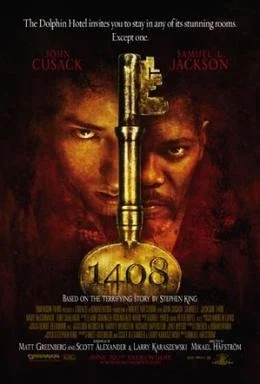
What’s It About?
1408 follows Mike Enslin is a cynical writer who specializes in travel guides about haunted hotels, despite not actually believing in anything supernatural for years.After receiving an anonymous postcard warning him not to enter Room 1408 at New York’s Dolphin Hotel, of course, Mike is determined to check it out and then check in. (See what I did there?)
As soon as Mike enters Room 1408, he quickly discovers the hotel room isn’t merely haunted, it’s malevolent. The room, or the entity that lives in the room, manipulates time, space, memories, and even the image of recently deceased daughter, Katie. The room pushes Mike through a psychological gauntlet that slowly erodes his skepticism and emotional defenses. His night turns into a brutal confrontation with his past trauma, his grief, and the limits of his sanity.
Direction Begets Theme
Håfström’s direction is tightly controlled in the early going, using quick, jarring shots to build tension inside the room as reality fractures around Mike. Cusacksells Enslin’s disaffected, sarcastic detachment and increasing desperation so well, it feels like that this character type is in his wheelhouse. The room forces Mike to relive the death of his daughter, subsequently forcing him to face his grief head on.
Cusack does a great job of navigating Enslin throughthe five stages of grief: denial, anger, bargaining, depression, and acceptance. This personal emotional journey gives the movie a psychological backbone that’s stronger than expected.
But for all its strengths, 1408 is a feature-length movie built from a short story, and at times, it feels it. The extended dream sequence, in particular, drags on long enough that it undermines its own twist. There are moments when the film simply slows down, unable to sustain the intensity it establishes early on.
The End…Over and Over
And then there are the endings. Four of them to be exact. The theatrical cut, where Mike survives and reunites with Lily, feels like the kind of clean studio note you’d expect from a PG-13 summer release. The director’s cut is bleaker and arguably more thematically consistent, killing Mike but giving him a final moment of peace. The other alternates, one where Mike dies and his manuscript is mailed off, and another where he survives and lives with Lily in California, offer slight variations that never quite feel definitive. Even the final shot, in some versions, borders on nonsensical.
Still, 1408 remains an intriguing horror film anchored by a committed John Cusack performance and the creeping atmosphere of a room that wants to unmake its occupant. It’s flawed, uneven, and occasionally dull, but when it works, it works, delivering a claustrophobic descent into personal torment that lingers longer than you’d expect from a mid-2000s studio thriller.
Forgotten Cinema Goes Horror
This movie was one of the first five films that the Forgotten Cinema Podcast covered for their first annual Forgotten Horror series. If you want to hear more of my thoughts and that of my co-host about movie, check out our podcast episode.
You can find the Forgotten Cinema podcast on Apple Podcasts, Spotify, and YouTube.
About the Michael Field
I’ve been telling stories my whole life, on film sets, behind microphones, on the page, and in late-night writing sessions that stretch until morning. From short films and feature scripts to podcasts, digital series, and novels, I’m drawn to characters who wrestle with identity, legacy, and the choices that define them.
Over the years, I’ve directed more than a hundred shorts, co-created the Forgotten Cinema podcast, and written scripts that blend pulp adventure, supernatural mystery, and human drama. My novels carry that same mix of heart, danger, and imagination, expanding my storytelling into new mediums and audiences. But at the center of it all is one simple thread: I believe stories are how we connect, how we remember, question, laugh, and imagine. Check out my personal website for more.
Storytelling isn’t just my career; it’s the way I move through the world.
