
Stunt Coordinator Ian Max Eyre on Action Design, Indie Horror, and Micro-Studios
Editor’s Note: Creativity often lives at the intersection of two unrelated fields. For Ian Max Eyre, that intersection is Physics and Adrenaline. Ian isn't your typical filmmaker. He is a Georgia Tech-trained mechanical engineer who realized that the laws of physics…force, mass, acceleration, are the exact same principles needed to execute a safe, bone-crunching movie stunt.
In this interview with our contributor Clinton Siegle, Ian breaks down his journey from engineering student to Hollywood Stunt Coordinator (The Walking Dead, Baby Driver), and shares his vision for a new kind of "Micro-Studio."
Q&A Interview:
Q: You’re known for blending your Georgia Tech mechanical engineering background with stunt work and mechanical special effects. How did your engineering training directly shape the way you design or approach stunts on set?
A: Engineering taught me how to think and research, and apply knowledge into design. The overlap with stunts is the calculated risk, understanding of material strengths, and knowledge of acceleration and deceleration for creating the human and mechanical appearance of violence on the movie screen. My stunt coordinating reel showcases quite a few stunts I’ve designed that required my degree.
Q: You’ve said you’re seeking George P. Burdell stories and Ramblin’ Wreck Parade contraption lore for a Georgia Tech documentary. What drew you to those uniquely Tech traditions, and what kind of stories are you hoping to uncover?
A: I have a fondness for my 7 years pursuing an undergraduate degree at Ga Tech, and all its traditions. I have the most nostalgia for the pranks and hi-jinx, especially the legend of Burdell and the non-direct drive vehicles called Contraptions during the Ramblin’ Wreck Homecoming Parade. In fact, two years ago I entered an alumni contraption and hope to perfect it this year.
Q: TripleDare Stunts developed the all-electric TripleDare Bike camera platform. Can you walk us through the engineering challenges behind building a high-performance, silent camera motorcycle for film production?
A: The TDS Bike was a modular camera platform for creating unique chase shots for movies. The beauty of an electric motorcycle is there is no gear-shifting to throw off the balance of a camera. And two wheels allows some clever shots that are hard to recreate with other tools. I built the camera chase bike because I noticed that all action directors had access to a particular tool that helped them design unique shots. Alas, the factory recalled my model due to discontinued support of its aging batteries, so I no longer have this gadget. Since its inception, camera size and support systems have technologically advanced, so I will have to redesign the whole platform if I decide to rebuild it.
Q: Your stunt career spans major productions like The Walking Dead, Baby Driver, and even Indiana Jones & the Kingdom of the Crystal Skull. What’s one stunt or rig you’re particularly proud of—either for its complexity or the problem-solving behind it?
A: I remember once coordinating a roller blader grinding a rail on the edge of a 9-story roof, for a Mennen deodorant commercial. I noticed that the roof was covered in 24” concrete tiles, so I went on a satellite map to see the plan view of the roof with a perfect grid. This allowed me to design and build a safety cable rig that allowed the performer to access the rail for a specific, short distance, and allowed me to build a limit to his travel as well as a backup plan to pull him quickly to safety if he lost his balance. That roller blader had mad skills and nerve, but I had his back.
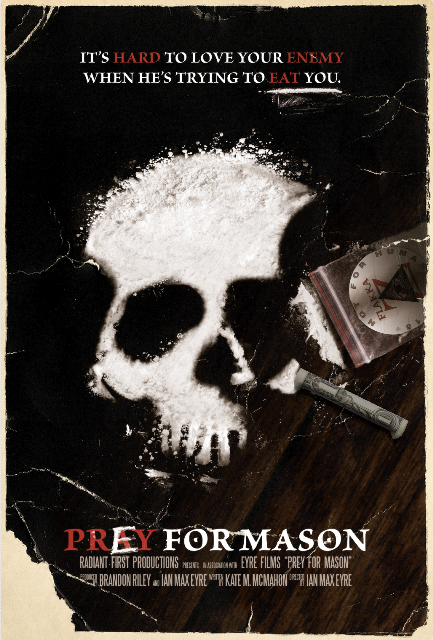
Q: PREY FOR MASON is positioned as your feature directorial debut and explores horror through psychological and spiritual lenses. What personal themes or questions drove you toward this story, and why horror as the vehicle?
A: I was invited to direct Prey for Mason, after giving notes on the script. I felt a connection to the main character, who reminded me of my high school self; not too sure of myself, a bit sheltered, and judgy about other people’s choices. I put myself in his shoes; What would I do in a situation where I had to confront a bully who turns into a monster, and could I love him despite him wanting to hurt me? This will be my next project, as we found the perfect location in Memphis, TN.
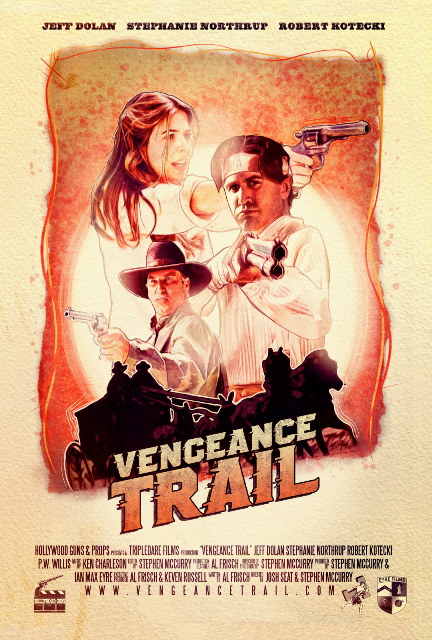
Q: You’ve produced or co-produced films ranging from Westerns (Vengeance Trail) to martial-arts action comedies (Acts of Violence). How do you adapt your directing and stunt-coordination style across such different genres?
A: Directing and stunt coordinating always serves the story. And each genre has its own story rules and conventions and audience expectations. The director sets the vision and all the other departments serve that vision. When I set out to direct something, I study what others have done in that genre and get creative without being too familiar or so unique that the audience can’t connect. I’ve done well with physical comedy and action, so everything I direct will probably have some of those elements.
Q: Eyre Films is being reinvented as a micro-studio with a slate of genre films. What’s your long-term vision for a “micro-studio,” and how do you see it competing or complementing the modern indie film ecosystem?
A: Investors want to diversify risk, and I realized that most of my movies have a genre niche and a young male audience, so I want to make a slate of low-budget horror movies that expands into other genres such as action, comedy and sci-fi. I’m just not interested in making dramas, and they’re harder to sell. The indie film model is changing now that the tools are available to go directly to the audience. The challenge is getting attention among the noise, I can put a billboard up in the jungle that nobody sees, so I’m focused on building a fanbase and creating opportunities for them to participate in the process at every stage, from development through test screenings and grass-roots promotion. I used to hear that Show Business is more business than show, but I’m realizing that it’s more marketing than show.
Q: Your Myers-Briggs type is ESTP, and your CliftonStrengths include Activator, Command, and Self-Assurance. How do those strengths show up in the high-pressure environment of stunt coordination and directing?
A: For me, the main reason to know my strengths is so I can manage my weaknesses by collaborating with people who have found their genius in other strengths. I know that I like to learn, but I also get antsy if I talk about doing something for too long without action. Then sometimes, I act without a full plan and end up creating ‘orphans,’ projects that are under-funded that I’m unable to complete. By creating in a community with collaborators, hopefully more voices will not only make a better project, but the projects will have stronger legs and a longer tail due to trusting others. This is why I’m creating Plumb Tales, an experiment in indie-film marketing.
Q: Plumb Tales is your effort to bridge faith-driven audiences and gritty, genre-based filmmaking. What gap do you see in the market, and how does faith-informed storytelling coexist with intense genres like horror or action?
A: There are no broadcast standards on streaming channels, so the movies my older teens watch can be quite rough, junk food for their mind. My kids are beyond the age for watching a family movie with us parents where we can have a discussion about what they ingested through their eyes and ears. Churches can only play all-audience, family fare, which has created a demand for non-edgy movies that parents like but young adults avoid. I want to create, and encourage the creation of, movies that young people want to watch purely based on entertainment value, but have nutrition for the soul that make them think deeper about life and relationships. I don’t believe any topic or genre is off limits for a Christian storyteller, but how we present the audio-visual elements — and their effect on cast, crew and audience — should definitely be considered. PlumbTales is the creator community and Plumb News is a curation of movies we appreciate that approximate the values of Plumb Tales. A plumb bob is a weight on a string that points to True Vertical, aka Absolute Truth. No entertainment will completely honor this, but we encourage filmmakers to pursue this ideal.
Q: You’ve been part of both the creative and physical sides of filmmaking—writing, producing, directing, rigging, and performing stunts. What advice would you give aspiring filmmakers who want to combine technical skills with creative storytelling in a similar way?
A: Everyone now has filmmaking tools in their pocket, and storytelling is as simple as someone wanting something that’s hard to get, and the choices they make to get it. A thirty-second commercial has all the same story beats as a feature film, in fact a good fight scene does as well. My film school was the 168 Hour Film competition, speed filmmaking based on Scripture. Story is story, created by God, universal to the human experience. What’s stopping you from telling your story?
Thanks for these amazing questions. Perhaps the best way to track me down is my Linktree.
Bio:
Ian Max Eyre is a Georgia Tech–trained mechanical engineer turned action director, stunt coordinator, and filmmaker. With expertise in stunts, mechanical effects, and genre storytelling, he leads Eyre Films and TripleDare Stunts while developing his feature debut, Prey for Mason, and preserving Georgia Tech traditions through documentary work. He’s also working on connecting fans, funders, and filmmakers — who love genre movies but are unsatisfied with secular Hollywood movies and risk-averse Faith films — in a creator community called Plumb Tales.
● IMDb
Interviewer Bio:
Clinton R. Siegle is an award-winning independent filmmaker, writer, and interviewer whose work has screened at 146 international film festivals and earned 14 awards. His films explore the boundary between the real and the surreal, often examining time, perception, and the human experience. Beyond filmmaking, Siegle is a cultural interviewer and archivist, documenting long-form conversations with artists, creators, and thinkers. As a writer and essayist, his work—spanning fiction, cultural commentary, and experimental storytelling—has reached over 8.49 million views worldwide. Through film, writing, and dialogue, he bridges history and myth, science and speculation, inviting audiences to question the world they inhabit.
