The Truth and Consequences of My Creative Journey
A Creative Perspective by: Steve Goldsmith (SteveG)
Hola, I’m Steve Goldsmith. Writer, expat, dreamer. For most of my life, I believed I was a writer… while secretly knowing I wasn’t.
Self-doubt is an insidious beast. It coils around the brain stem and squeezes the life out of creativity. Until, one day, it doesn’t.
When I retired at sixty and moved to Costa Rica, I filled notebooks with ideas, stories, and fragments. They piled up in drawers, unseen. I was proud of them, but I shared them with no one. When I say I filled notebooks and tucked them away, that doesn’t mean I was idle. Costa Rica didn’t turn me inward so much as it gave me room to build. I started a community foundation, Vida Sostenible Nuevo Arenal, to support local schools, street dogs, newborn babies, and families who needed help before paperwork caught up with reality. I helped fund backpacks, veterinary care, milk, medicine… small interventions with immediate consequences.
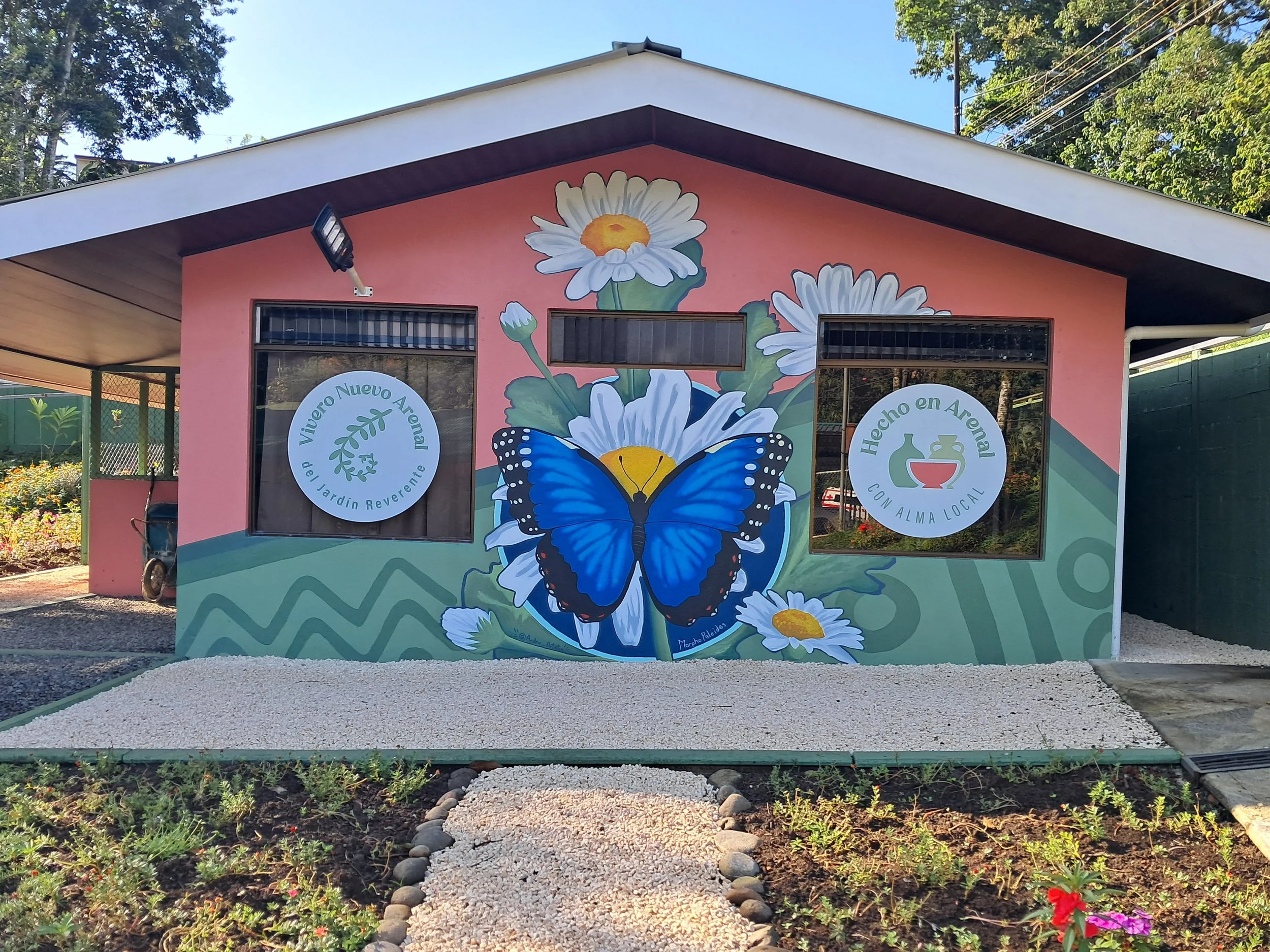
I also founded El Jardín Reverente, a community botanical garden rooted in restoration and reverence. It grew into a living space with a butterfly sanctuary and an artisan gift shop, Hecho en Arenal, showcasing local makers and keeping money circulating where it was earned. Plants were cataloged. Trails were cut. Things took shape.
I was creating constantly—just not on the page.
Looking back, I see the pattern clearly: I was comfortable building things that served others, but reluctant to offer my own voice for inspection. It’s easier to plant a tree than a sentence. Trees don’t ask what you meant. Writing would.
In March of 2025, I finally woke up. I wrote in earnest.
My first novel, Elba Kramer: The True Autobiography of a Pathological Liar, poured out in six weeks—97% true, 2% exaggeration, 1% outright lies. It felt good. Dangerous good. That led to The Last Heretic, a historical fiction I had carried inside me for fifty years, and then Dear Dairy, inspired by my years teaching special-ed math. Each book was a different genre, a different experiment, but all carried the same voice: searching for truth, demanding consequences.
Rejections came—polite notes, mostly silence.
Silence, it turns out, is the most efficient teacher of self-doubt. A rejection at least acknowledges your existence. Silence invites you to erase yourself preemptively. You begin editing not your sentences, but your ambition.
Maybe it’s not ready. Maybe it’s not marketable. Maybe you should be sensible.
After enough unanswered submissions, you stop imagining a reader on the other end. You start imagining a gatekeeper shaking their head, already tired of you. That’s the moment many writers quietly convert passion into hobby and call it maturity.
I didn’t. Eventually, the math became simple: no one was coming to grant permission. If these books were going to exist, it would be because I put them into the world myself.
After the fiftieth passive rejection, I stopped waiting. On September 29th, I self-published all three on Kindle. A few sales, warm reviews, a heartbeat. That was enough to keep going.
Soon, Forty-Two Flash Fever Dreams hit #3 in Short Fiction. Satirical shorts followed, bundled into The Infernal Twins. Folk horror arrived with The Old One and The Hunger, and then The Last Known Position, three stories of historical disappearances. Now I’m deep into The True Virgin, narrated by the teenage daughter of Satan. Ancient as the cosmos, witty, furious, brilliant, and not quite as evil as she hopes.
I write across genres—literary fiction, historical epic, satire, folk horror—not because it’s smart, but because it’s necessary. Each book asks a different question about truth. And each book explores a different set of consequences.
Six books. Six genres. All over the map. Real authors, I’m advised, choose a lane. They build a brand. They optimize. They behave.
But voice doesn’t live in a genre. It lives in obsession.
Mine has always been the fault line between what we say is true and what we reward as true. Satire, history, horror, autofiction, literary fiction, flash fiction. These aren’t detours. They’re tools.
Some truths require a scalpel. Others need a hammer. A few demand laughter, because laughter is the only solvent strong enough.
Choosing one genre would have been tidier. Writing honestly was not.
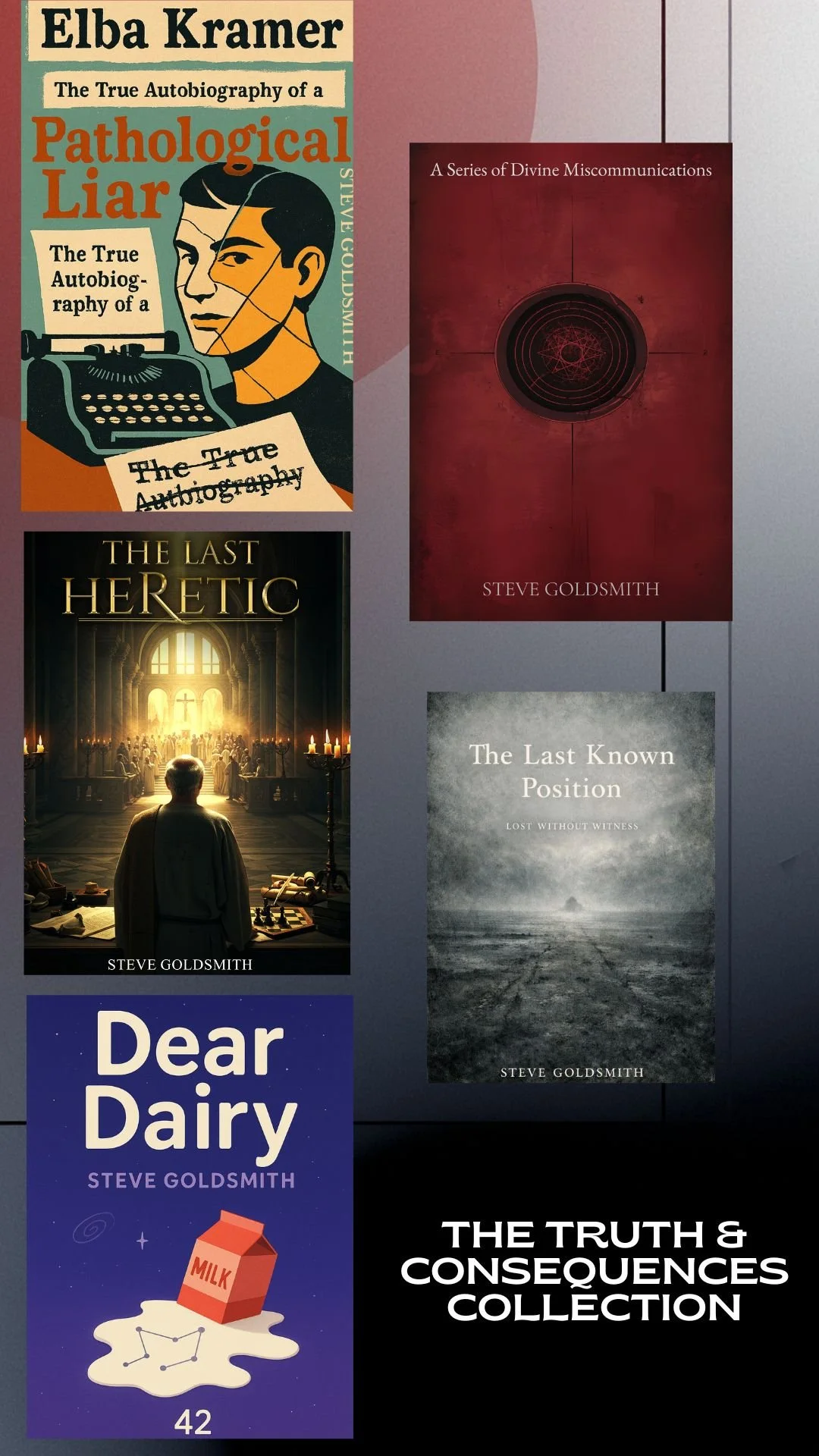
Each volume examines a different kind of truth… and the damage it does, or prevents:
• Elba Kramer: The Personal Truth ⇒ Personal truth lies to survive.
• The Last Heretic: The Institutional Truth ⇒ Institutional truth lies to endure.
• Dear Dairy: The Structural Truth ⇒ Structural truth lies by design.
• The Infernal Twins: The Cosmic Truth ⇒ Cosmic truth laughs at certainty.
• The Last Known Position: The Historical Truth ⇒ Historical truth forgets, then rewrites itself.
• The True Virgin: The Biblical Truth ⇒ Biblical truth contradicts itself—and dares you to notice.
Different genres. Same question. What happens when truth collides with power, fear, love, or belief? The consequences change. The cost does not.
Amazon and KDP gave me a platform to get started. Kobo and Draft2Digital expanded it worldwide. Now I am poised to find my readers across a dozen or more storefronts. Now my truth is unapologetically on display. But the real journey hasn’t been about rankings or platforms.
It has been about silencing doubt, embracing risk, and sharing words that mattered.
If you’re scribbling in notebooks, doubting yourself, or waiting for permission…
Don’t. Start. Write. Edit. Share. Reflect. Refine. Publish.
The journey is worth it.
Author Bio
Steve Goldsmith (SteveG) is a retired teacher, technologist, and expat living in Costa Rica. He founded community projects in Nuevo Arenal and writes across genres to explore the fault line between what we call truth and what we reward as truth. His work appears in self-published collections and online journals.