
Why Your Social Media Videos Bomb (And How Storyboards Can Fix Everything)
A Creative Hack by: Markus Etter
Just last week, I watched a creator spend four hours shooting a TikTok.
Think about it, four hours for mere fifteen seconds of content. She shot 47 takes. Changed outfits three times and tried six different angles. And you know what happened? The video flopped. 312 views. Three likes.
Meanwhile, another creator I know spent twelve minutes planning, twenty minutes shooting, and hit 340,000 views in two days. He had the same niche, same follower count, but way different approach.
The winner used a storyboard. The loser winged it.
Why Your Content is Bleeding Money (Even if you Can't See It Yet)
Every video you post without a plan costs you something you can't get back - both money and time. The time your audience could spend watching your content instead of scrolling past it. The time you waste reshooting because you forgot to capture the right angle. The time you burn in editing, trying to salvage footage that doesn't tell a story.
What you need to understand is that storyboarding isn't about drawing pretty pictures. It's about respecting your own time and your viewer's attention span. Because on TikTok and Instagram, you don't get a second chance. You get few seconds before someone decides you're not worth their time.
What Actually Happens When You Don't Storyboard
You show up to film all prepared. You’ve got your ring light. Your camera is charged. You press record and... you just sit there, thinking…Questions run through you brain. What angle should you use? Do you start with the product or yourself talking? Wait, what were you even going to say? So you just try stuff. You film a bunch of scenes hoping something works. Then, in editing, you notice you’re missing a close-up that would’ve made the reveal amazing. You don’t have a clean shot of the logo. The timing is off, and you can’t fix it because you didn’t get the right B-roll. You upload it no matter what. Because you already wasted three hours on it. The algorithm doesn’t care how hard you tried, it cares about watch time, and watch time usually means you need structure.
The Anatomy of Videos That Bring Results
Every social video that performs has the same skeleton. Most creators never see it because they're too busy staring at the surface level stuff like transitions and trending sounds. But pull back the curtain, and you'll find the same pattern:
Frame 1 creates immediate tension. Not curiosity. Tension. There's a difference. Curiosity is "I wonder what this is about." Tension is "I need to know what happens next or I'll lose my mind."
Frames 2-8 escalate that tension. Each frame either deepens the problem or teases the solution. Nothing is wasted. Every cut has a job.
Frames 9-12 deliver the payoff. Fast. No fluff. Just value.
Frame 13 demands action. Not "hope you enjoyed this!" but a direct, specific instruction that turns passive viewers into active participants.
You can't build this structure while you're filming. Your brain doesn't work that way. You need the storyboard.
How Storyboarding Actually Works (Industry Secrets)
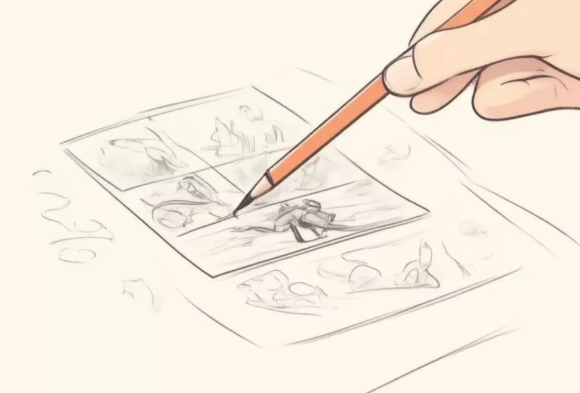
Most people think storyboarding means drawing elaborate sketches of every scene. That's filmmaker stuff. You're not Scorsese. For social media, your storyboard is simpler. It's a map of moments. Take a piece of paper. Draw six to eight boxes. In each box, write three things:
What the viewer sees. Not "product shot" but "extreme close-up of texture while finger runs across surface."
What text appears on screen. The exact words. Not "something about the problem" but "Still washing your face with bar soap?"
What happens next. The transition. The cut. The reveal. Be specific.
This takes eight minutes. Maybe twelve if it's your first time.
Now you have a blueprint. When you shoot, you're not creating. You're executing. There's a massive difference.
Execution is faster, cleaner, and produces better results because you're not burning mental energy on decisions. You already made them.
Platform-Specific Storyboard Strategies That Actually Matter
TikTok rewards chaos. Your storyboard should reflect that. Quick cuts. Unexpected angles. Visual interruptions every 1.5 seconds. The platform algorithm literally measures "rewatch rate" so your storyboard should include at least one moment designed specifically to make people scrub back.
Instagram wants polish. Your storyboard should map out consistent lighting, clean backgrounds, and smooth transitions. The platform skews slightly older and viewers expect production quality. Your storyboard isn't just about content flow but about visual coherence.
YouTube Shorts sits in between. It's less chaotic than TikTok but less polished than Instagram. Your storyboard should prioritize clear value delivery over style. Viewers come to YouTube to learn or be entertained in specific ways. Make sure your storyboard answers "what's in it for me" within three frames.
The 4-Box Minimum Viable Storyboard
You don't need twelve frames to make this work. You need four.
Box 1: The Interrupt. What stops the scroll? Write the visual and the text. Be specific enough that anyone could recreate it.
Box 2: The Promise. What are you about to deliver? This frame should make someone think "okay, I'm interested."
Box 3: The Delivery. The actual value. The transformation. The reveal. Whatever you promised in box 2.
Box 4: The Action. What happens now? Follow? Comment? Click? Pick one and make it explicit.
Shoot these four frames with intention and you're already ahead of 90% of creators who are just pointing cameras at themselves and hoping.
Why Tools Matter (But Not the Way You Think)
You can storyboard on napkins. I've seen it work. But using actual storyboard software makes you much faster.
The team at Story-Boards.ai gets this. Founded in 2023 by filmmakers Markus Etter and his co-founder, they built an AI-powered platform that generates visual storyboards from text descriptions. You type "close-up of hand holding product, dramatic lighting, modern aesthetic" and the tool shows you what that looks like.
Their comprehensive guide on how to storyboard for social media videos breaks down the technical framework for TikTok, Instagram Reels, and YouTube Shorts with platform-specific strategies you can implement immediately.
The point isn't that you need their tool. The point is that friction kills execution. Anything that makes storyboarding faster means you'll actually do it.
The Real Reason Storyboards Win
When you storyboard, you're forced to think like your audience before you think like a creator.
You can't hide behind "I'll figure it out when I'm filming." You have to answer the hard questions upfront:
Why would someone care about this in the first second?
What's the absolute clearest way to show my point?
Where will people drop off and how do I prevent it?
What action do I want them to take?
These questions are brutal. They expose weak ideas before you waste time executing them.
That's the real value. A storyboard kills bad videos before they're born.
What to Do Right Now
Pull up your last five videos. Watch them with audio off. Time how long before your main point appears. If it's more than four seconds, you're losing people. Now grab a piece of paper. Draw four boxes. Pick one video idea. Storyboard it properly this time.
Box 1: What visual and text combination stops someone scrolling in 0.8 seconds?
Box 2: What makes them decide to keep watching instead of swiping?
Box 3: What value are you delivering that makes them glad they stayed?
Box 4: What specific action should they take right now?
Fill it out. Then shoot it exactly as storyboarded. No improvisation. Just execution.
Post it. Measure it against your previous content.
The difference won't be subtle.
The Compounding Effect
One good storyboard makes one good video. Ten good storyboards create a system. You start seeing patterns in what works. The hook that performed best gets reused with variations. The transition that boosted retention becomes part of your template. The CTA that drove follows gets refined and optimized.
Over time, your storyboards become a library of tested frameworks. You're not starting from zero every time. You're building on proven structures.
This is how creators go from posting three times a week to posting daily without burning out. They're not more creative. They're simply more systematic. The storyboard is the system, a must-needed structure.
What Separates Good from Great
Good creators make videos people watch. Great creators make videos people rewatch, save, and share. The difference is intentional structure. And structure requires planning. You can keep improvising. Keep hoping the algorithm blesses you with luck. Keep wondering why some videos pop and others don't.
Or you can storyboard. Test. Learn. Optimize. Repeat.
The creators winning right now aren't more talented. They're just more prepared.
Your competition is still winging it. They'll keep winging it because planning feels like work.
That's your opening. Take it. Storyboard your next video. Shoot it clean. Post it confidently.
Then do it again tomorrow. That's how you win.
Author Bio:
Markus Etter is the CEO and co-founder of story-boards.ai, founded in 2023 TaleTech Studios, where he's revolutionizing the pre-visualization process for filmmakers and visual storytellers. A graduate of the prestigious London Film School LinkedIn, Markus brings deep filmmaking credentials to the tech world, having trained as a director and built years of hands-on experience creating visual effects Eddymotion. His passion for storyboarding stems from witnessing firsthand how the traditional process can be prohibitively expensive and time-consuming, particularly for independent creators and smaller productions. By combining his intimate understanding of cinematic language with cutting-edge AI technology, Markus and his team at TaleTech Studios TaleTech Studios are democratizing access to professional-quality storyboarding tools, empowering storytellers across film, advertising, and content creation to transform their scripts into vivid visual narratives with unprecedented speed and accessibility.
