
ART AND THE AGE of AI
A Creative Perspective by: Chris Wax
I have probably considered myself an artist before I ever truly considered myself much at all. Creating has always felt like my most natural state and like most of us, I began drawing with crayons from an early age and quickly moved on to replicating the Sunday comics like Garfield and Snoopy from the Peanuts gang, finding a lifelong love for art and animation.
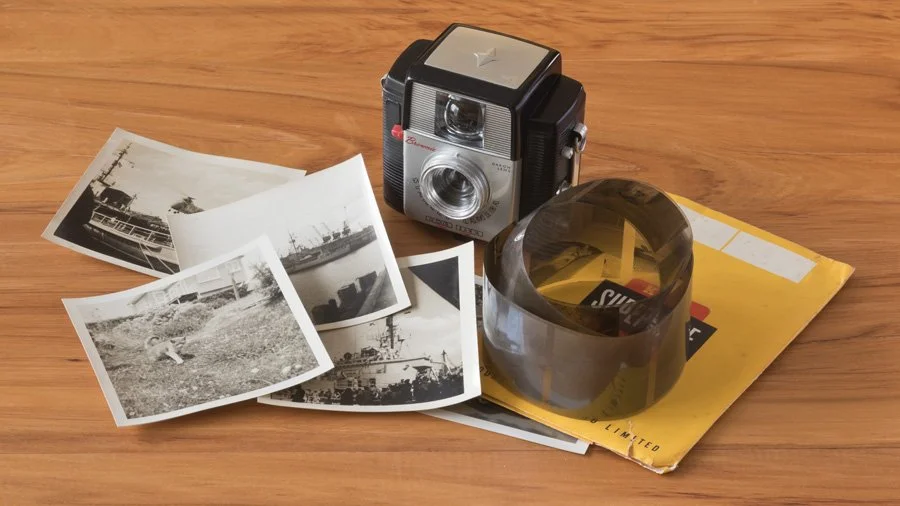
When I was around seven years old my great-aunt gifted me her old 1960 Kodak Brownie 127mm film camera. This was a cheap, mass-produced, plastic, fixed-lens viewfinder, a precursor to Kodak’s even more user-friendly 35mm format. Cue Paul Simon’s ode to Kodachrome.
Cheap or not, that little camera had me feeling like Jane Goodall capturing the wild world around me through its tiny lens. I found a new calling in that Brownie and later went on to study film and photography. Yet I never abandoned my love for the pencil or for my whacky cartoonist heroes like the great Don Martin or the irreverent Bill Watterson. My passion for illustration was largely what got me into art school in New York, circa 1993.

Little did any of us know then, the 1990s were an incredible time for artistic expression. Unforgettable music was being churned out by young new bands who are now immortalized in the Rock & Roll Hall of Fame. Page-turning novels were being released by some of the biggest names in that industry. Blockbuster movies were released alongside Oscar-winning indie darlings that would inspire the next generation of writers and filmmakers like myself. It was truly an amazing time to be an artist. Meanwhile, new technologies and innovations were being developed with whispers of how art would be forever changed by a looming digital age. The apex of that technological shift occurred at the very same time I was undertaking my art conservatory studies. Spending six hours one day drawing the lowercase letter “e”with a pencil and clipboard of paper balanced on my lap. The next, sat behind a computer spitting out a laser copy of the same perspective letter from Adobe Illustrator in about thirty-five seconds. Luckily, if you’re ever trapped on a desert island with me, I can wrangle us up a few hand-drawn perspective letters: “Help!”
I believe one of the greatest markers to the advent of this digital era in art came with a little upstart 3-D graphics studio called Pixar, which released the animated feature A Toy Story in 1995.
I remember seeing this film for the first time and marveling at details of wood grain and the complex use of light and shadow. The same way I first starred in awe over my discovery of Magritte’s oil painting La durée poignardé. Like classical surrealism, this digital animation was different and pushed the boundaries of what was possible in both storytelling and visual expression.
Yet what Pixar was doing with computer animation was sacrilegious to the historic industry of hand-painted cels photographed one at a time, using twenty-four frames per second to “animate” each scene. This new technology, as fascinating as the results were, was thought to be the death of animation itself and soon all its artists would be out of work. The truth is, Pixar’s technology made way for a booming digital film industry which led to at least six major Hollywood studios launching robust animation divisions who have since spent tens of billions of dollars on their budgets while employing hundreds of thousands of artists in the process.
In short, the digital age did not kill animation, it pushed the art form into mass-market appeal and global theatrical success with huge financial windfalls. Telling elevated stories through unmatched visual experiences few could have imagined at the time.
The art of storytelling itself has always chased the technology of the times. What likely started with tales around a fire or drawings on cave walls evolved into outdoor Shakespearean theatre and then into Broadway plays. From silent film to talkies, black and white into color, 35mm into IMAX, stereo into Dolby Atmos surround sound, and brushpainted frames into Pixar’s digital animation. The invention of Carl Benz’s automobile and Henry Ford’s assembly line transformed the way we move in the world. The Wright Brothers’ airplane changed the way we travel. The iPhone reinvented how we share and find information. There is no mistaking that we exist in an ever-evolving and escalating technological age, and AI promises to be its biggest leap to date.
AI may be implemented in as many things as electricity itself, and like the inception of the lightbulb, a subsequent candle industry may ultimately suffer. The way we work will undoubtedly change, and in the end unforeseen innovations will surely be born from it all.
The evolution of art and technology is everywhere we look and as the past would suggest, I do not worry that we will be replaced by AI. I believe AI will be yet another instrument to expand what and how we create and invent. How we bring art and thought into form. How we conjure expression, concept, and beauty into being.
I am not afraid of AI in the capacity that we will be put out of work as artists. Yes, an AI-driven evolution will shrink some facets of industries, much the way digital did to film, light bulbs did to candles and cars did to the horse and buggy. But in art, I trust that people will always resonate most with what took time, talent, energy, and difficulty. A mastery that only comes with decades of practice and effort. The ballerina, the concert pianist, the painter: those feelings that are expressed, which only sentient beings can appreciate through their shared experiences and understanding.
Though there is so much more nuance and such quickly moving facets to this ongoing conversation, I am resolute that our love for the arts will not be replaced by AI; it will be yet another vehicle to deliver it to us, or deliver us to it. My great-aunt’s sixty-five-year-old Kodak Brownie Starlet camera still decorates my mantle today, standing as a symbol of both the bygone tools of our craft and the evolving ways in which we create and experience the world around us. It serves as a daily reminder that all things do in fact change, and not to fear the ways in which they do, but to continuously find our place in what’s to come.

Author Bio:
For over two decades, Chris Wax has developed, produced, and written for major companies, such as Sony Pictures, The Wolper Organization, New Wave Entertainment, BaseFX China, Infinite Studios Singapore, Village Roadshow, and Humanoids.
Chris just completed his first novel, “Flipping The Script”, and is currently executive producing a landmark documentary in partnership with MLB Network, commemorating the 25th anniversary of 9/11, exploring the powerful role baseball played in the nation’s healing.
Follow Chris on Instagram: @therealwax / @chriswaxart / @flippingthescript_thebook
